
Correction: Performance Time
Please note there was a typing error in our full-page advert in the printed brochure.
The correct performance time is 19:30.
We apologise for any confusion this may have caused.
LAMENT OF THE WANDERING HEAD
Upcoming:12-13 November Voila! Theatre Festival

"A unique, inventive and important piece of work" — FringeReview (2026 Durham Fringe Festival)
A Note Before You Watch
Because there is a lot of spoken dialogue in Mandarin and Penang Hokkien, the English surtitles follow the pace of the dialogue closely during this performance.
We encourage you to read the synopsis before the show begins, so you can follow the story more easily and enjoy the physical performance and live music as it unfolds.
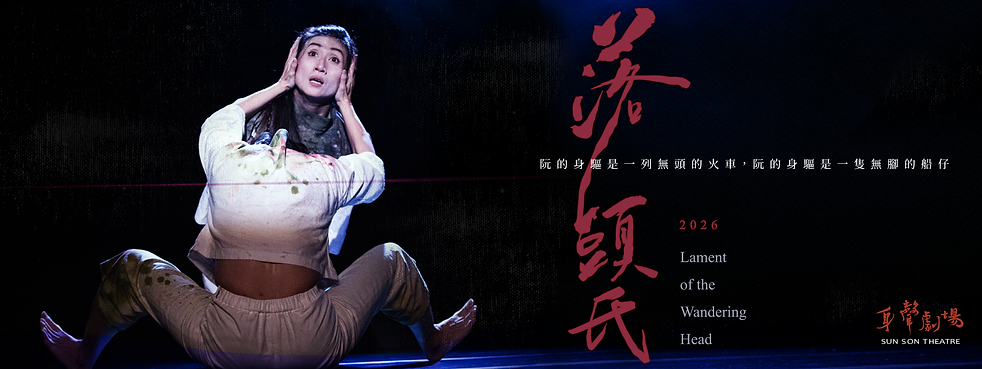
Synopsis
My body is a headless train
My body is a legless boat
To wander East? To wander West?
This is not a ghost story. It's a song of longing, a poem of memory.
Across China, Indonesia, Vietnam, Laos, and Malaysia, an old story is told of a creature whose head flies free from its body at night — known in different places as Penanggalan, or "the flying head." In some tellings, it's simply a monster. In others, it's linked to powerful sorcerers said to send the head out on dark errands.
Sun Son Theatre's Lament of the Wandering Head draws on this legend and turns it into something else: a story about women, memory, and the long journeys Chinese communities in Southeast Asia have made — and the histories that have gone with them. Combining theatre, live music, physical performance, and song, the piece uses this old, strange folklore to speak about very real experiences of leaving home and living far from it.
The story
The play imagines a family where the "flying head" runs only through the women — passed down across generations, in different countries and cities.
At the centre of the story is a young Malaysian Chinese woman studying in Taiwan. She keeps hearing a song calling her back — and carrying a drawing left to her by her father, she returns to Penang. There, she finds a house holding many headless bodies, each one waiting for its head to return.
Searching among them, she discovers she is part of this same lineage. But something has changed: the old story — of heads and bodies kept apart, waiting to be reunited — has faded from memory. Her head no longer flies away at night. Instead, her whole self simply keeps moving, from place to place.
Like many lesser-known stories carried by migrant communities, the flying head has become myth, ghost story, and lived history all at once. Sun Son Theatre uses it as a way of speaking about what it means for a community's history and culture to be pulled apart and carried in pieces — told through a mix of Mandarin and Penang Hokkien, alongside live music and song.
Production Team
Founder:Leonson NG(1973-2021)
Dramaturgy:KOH CHOON EIOW
Concept:CHUANG HUI YUN
DIRECTOR:CHANG WEI LOY、CHUANG HUI YUN
Playwright:CHUANG HUI YUN
Music Compose and Live Performance:CHEN ZI YIN
Vocal:LOW PEI FEN、CHEN ZI YIN
ACTOR:CHUANG HUI YUN, LOW PEI FEN, CHEN ZI YIN
Penang Hokkien Dialect Instructor ,Voice Over:WONG KIEF
Taiwanese Lyric Writer :LIU HSIU TING
Lighting Designer:PENG JIOU FANG
Sound Engineer:LIU SHIH WEI
Sound Technical Director:TP Sound Co., Ltd CHEN YU CHIEN
Costume Designer:TAN MENG CHIT
Props:CHANG WEI LOY
2026 July-August Durham Fringe Festival and Penang Georgetown Festival International Touring
Supported by National Culture and Arts Foundation, Department of Cultural Affairs, Taipei City Government, Taishin Bank Foundation for Arts and Culture
ABOUT THE SHOW
★Nominated 24th Taishin Arts Award★
★Nominated 2th Taipei Theatre Award Best Independent Group★
Lament of the Wandering Head is Sun Son Theatre's most recent work, premiering in Taiwan in 2025. It is perhaps the most demanding piece we have undertaken — in terms of history, text, and research — and we are honoured that, following its debut, it received nominations for Taiwan's Taishin Arts Award and the Best Independent Spirit Award at the 2nd Taipei Theatre Awards. We are now bringing it to the United Kingdom for the first time, and we hope it will find a meaningful connection with audiences here.
The piece draws its inspiration from the folklore of the flying head, found across Southeast Asia — spirits whose heads separate from their bodies at night. We took that image of bodily rupture and let it become a metaphor for the collective trauma and individual dislocation experienced by Chinese diaspora communities across the twentieth century and beyond, caught between nation, bloodline, and land. From there, we imagined a fictional condition that befalls only women. The story follows a Malaysian Chinese woman living in Taiwan who, as she begins to trace the scattered and unresolved stories of her diasporic past, finds herself drawn into an unexpected journey — a passage, as we came to think of it, between one ghost and another.
At its heart, the work is about what it feels like to belong to a diaspora — to carry a sense of disconnection from your own history and culture, and to be part of a community that has often been pushed to the margins or simply not heard. But we were also drawn to something more hopeful in the image. A head that detaches and yet keeps living felt, to us, like an honest way of describing resilience — the fact that people find ways to carry on, and sometimes even to rebuild, from the very places where something has been lost.
There are a few historical moments in the work that audiences may find it helpful to know. In 1931, British colonial administration merged Singapore, Penang, and Malacca into the Straits Settlements. In 1963, Taiwan, under martial law, applied a principle of bloodline nationality that classified all overseas Chinese as citizens of the Republic of China, regardless of where they actually lived or what they considered home.
The work was also shaped by a real case that we encountered during our research: a Malaysian Chinese student who came to Taiwan to study and died there under unexplained circumstances. For years, the family could not locate the body. It was only fifty years later that a gravestone was finally found. The student's mother, unable to recover from her grief, was eventually admitted to a psychiatric institution. This case had a significant influence on our decision to approach the work through a female perspective.
We have tried to handle this material in a way that reaches beyond its specific ethnic and historical contexts. The figure we kept returning to was what we call the “Yi Ren” — the outsider, the one who does not quite belong, the person whose sense of home is always uncertain. We hope that beneath the particular histories, the work touches something more universal: a metaphor for anyone in the contemporary world who knows what it is to feel displaced — wherever that displacement comes from, and whatever form it takes.
Sun Son Theatre has long held a distinctive place within Taiwan's theatrical landscape. The performers in this production have each spent over twenty years working together within the same ensemble. Our work is built on the shifting interplay between body and voice, full-bodied physical energy, sound transformed into invocation, rhythm into the pulse of life. Rather than fixing meaning, we hold it open — creating space for the audience to find their own way in.
In Lament of the Wandering Head in particular, the writing moves through feminine poetics, stream of consciousness, and fractured narrative — struggling and drifting in a way that feels closer to summoning than storytelling. It is a script that does not fully exist until it is performed.

Programme Notes — Lament of the Wandering Head

1. The Luo Tou People (落頭民) in ancient Chinese books
Picture:Katsushika Hokusai
(1760-1849)
Accounts of humans whose heads could detach and fly appear across several ancient Chinese books, including In Search of the Supernatural* (搜神記), Records of Strange Things (博物志), and Miscellaneous Morsels from Youyang (酉陽雜俎). Fei Xin, an interpreter who accompanied Zheng He's Ming Dynasty voyages, documented a people called the "Chong Luo Clan" in present-day central Vietnam in his work Overall Survey of the Ocean's Shores (星槎勝覽), noting they were known to eat human excrement. In Japan, the Night Parade of One Hundred Demons (百鬼夜行) includes a similar flying-head creature called the Rokurokubi. Across Southeast Asia, practitioners of powerful dark magic were said to send their heads flying as a form of sorcery — a tradition echoed in the Malay Penanggalan legend, widespread across Singapore, Malaysia, and beyond.
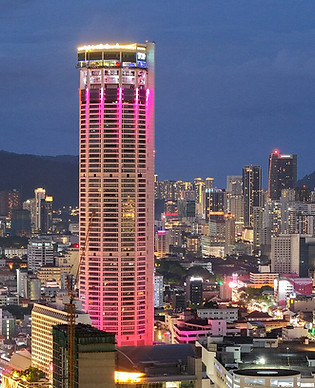
2. Penang Hokkien
Photo: Penang skyline
Penang (also known as Pulau Pinang) is Malaysia's third-largest city and home to its largest ethnic Chinese population. Penang Hokkien — also called Bieneng Hokkien — is a regional variant of the Southern Min (Hokkien) language brought by early Chinese settlers from Fujian province. Over generations, it absorbed vocabulary from Cantonese, Hakka, Malay, and English, evolving into a distinctly hybrid tongue.

3.Sun Yat-sen and Penang
Photo: Sun Yat Sen museum
Sun Yat-sen famously declared that "Overseas Chinese are the mother of the revolution." Penang was one of his most vital overseas bases — home to a branch of the Tongmenghui (Revolutionary Alliance) and a source of enthusiastic fundraising from the local Chinese community. A museum commemorating his revolutionary activities still stands in Penang today. In the production, Sun Yat-sen is likened to a figure of prophetic destiny, drawing on two classical Chinese texts: Tui Bei Tu (推背圖), a Tang Dynasty prophecy derived from the I Ching, and Shao Bing Ge (燒餅歌), attributed to the Ming Dynasty strategist Liu Bowen. Both have long been acclaimed as China's foremost books of prophecy, and later interpreters have read into them allusions to Sun Yat-sen's failed uprisings and his years of exile abroad.

4. Yu Zifeng (俞自鋒, 1941–1963)
Photo: Yu's tomb
Yu Zifeng was a Malaysian student studying in Taiwan. A student in the journalism department in 1962, he was found dead behind Zhinan Temple in 1963. The case shifted from suicide to disappearance, then "fate unknown." Fifty years on, his family, living overseas, finally located his grave in the Liuzhangli mountain area. The circumstances of his death remain unresolved.
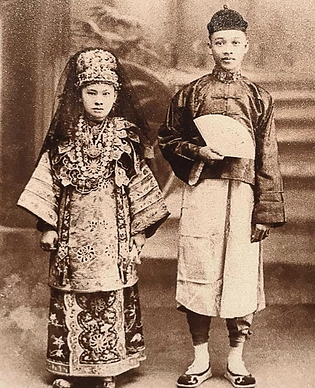
5. Baba Nyonya
Images courtesy of pinterest.com/hi_hi_mun
The Peranakan Chinese — known as Baba Nyonya — are a distinctive ethnic group in Southeast Asia, descended from Chinese immigrants who settled in the region and intermarried with local communities. Men are called Baba, women Nyonya. While many Chinese customs and traditions are preserved, the Peranakan have integrated deeply into local cultures, adopting local languages and ways of life over the generations.
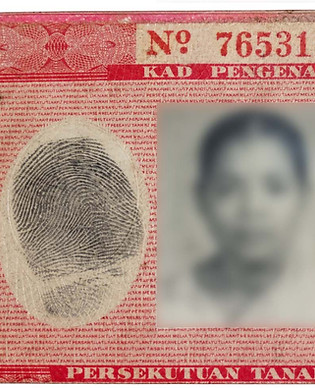
6.The Red IC
Photo: old red ic
Malaysia issues three categories of identity card: the blue MyKAD for citizens, the red MyPR for permanent residents, and a green card (KMyPR) for those who have resided in Malaysia for five years or more. When Malaysia gained independence in 1957, many long-established residents — including significant numbers of Chinese and Indian Malaysians — were not automatically granted citizenship. Despite stable livelihoods, they were unable to access full civic rights and often faced discrimination.

7. Rojak
A Malay word for a mixed salad common in Malaysia, Singapore, and Indonesia, typically combining cucumber, pineapple, turnip, green mango, guava, squid, and youtiao (fried dough), dressed in a rich sauce. Rojak (meaning "a jumble" or "hodgepodge") is also widely used as a metaphor for the multicultural character of Malaysian and Singaporean society.
2026 Taishin Award Nominee Artist interview Interview and text: Chen Wei-Chen "My body is a headless train, my body is a legless boat — how do I find my way? How do I find my way?" Two performers stand onstage, a white cloth linking their bodies and heads together. In the light, their silhouettes make a striking image of a body and head living apart from each other. Suddenly, like a figure at a shrine, the musician strikes the Southeast Asian gamelan and South Seas drums alone — the opening music stirs the performers' bodies into restlessness. A folk tune played on the duck-call flute pulls the two performers apart again. Mandarin threads through Penang Hokkien, and the story begins — a cross-century tale of Chinese women's diaspora, told through movement and music, traveling from the South Seas across the sea to Taiwan. Starting from "no story" Sun Son Theatre's members carry a deep Malaysian Chinese background, and the creative team behind Lament of the Wandering Head — beyond coming from Kuala Lumpur and Penang — includes Taiwan-based CHUANG Hui Yun, who first conceived the piece and co-directs with Kuala Lumpur-born CHANG Wei Loy. She also co-stars with Penang-born LOW Pei Fen. Building on the company's core spirit of "performance, music, and dance as one," this is the first time they've taken on a text with real historical depth. "We used to always look for a third force — a kind of bodily energy beyond the everyday. This time, a text came into it, and I think it's because as we got older, we started asking different kinds of questions, trying to find ourselves," says co-director CHANG Wei Loy. The making of Lament of the Wandering Head combined fieldwork with personal reflection, and grew into a text with real weight — one that traces the Chinese diaspora, nation and colonialism, and the fate of women, in real depth. The spark for Lament of the Wandering Head came from two lines Chuang Hui Yun wrote down one day: "My body is a headless train, my body is a legless boat." The words stayed with her, and she felt the pull to develop them into a full piece — so she invited LOW Pei Fen, who's from Penang, to build the work together, starting from her own life experience. But Pei-Fen's response was: "I don't really have a story." Having lived in Taiwan for so long, she'd come to feel her life just didn't have anything worth telling. "So this piece really did start from having no story." The story-less "Wandering Head" comes from a South Seas legend about a ghostly creature whose head and body live apart — the company turned it into a fable about women on the move. From plague control under colonial rule in the 1930s, to interethnic marriage in the 1950s, to the death of an overseas Chinese student in Taiwan in the 1960s, all the way to a Malaysian Chinese woman's accidental death in Taiwan in the 2020s — the company went looking for the women lost along the way in this diaspora, trying, piece by piece, to give them back a body (even one living apart from its head) and a story (even one told across different languages). On a stripped-down stage, these scattered Chinese women slowly take shape — not as ghosts anymore, but as a lineage of "outsiders from a distant land" — finally able to be told, to be seen, to be heard. Filling the gaps with two languages, and shaping the sound Someone who thought of herself as "a person with no story," performer LOW Pei Fen has always taken the stage through movement and music rather than words — she's never been comfortable with language. But working with CHUANG Hui Yun, she slowly dug up pieces of her own and her family's history. "Hui Yun, as an outside observer, asked me to write down the smells, the colors of home. As I slowly worked back through that, I remembered — when I was a kid, the adults used to scare us with stories about 'flying heads.' Maybe I don't really have what you'd call a story, but I do have a kind of energy, a resilience — always wanting to head out into the world. It's funny, looking at it against that legend — it really speaks to a kind of drifting identity, an energy that's always in motion." But with one performer from Taiwan and one from Malaysia, how do you put this tangle of nationality, colonial identity, and geographic drift onstage? In the end, the two of them exist almost like mirror images of each other, or like two halves of one body, each speaking a different language. It was LOW Pei Fen's first time using her mother tongue, Penang Hokkien, onstage, while CHUANG Hui Yun speaks crisp, clear Mandarin. Whenever something couldn't quite be said, she'd just sing it in Penang Hokkien instead — and that, almost by accident, captured with real precision the wordless struggle and inner split of someone living between a dominant language and their mother tongue. The live music is one of the piece's key threads. Music designer and performer Chen Zi Yin boldly blends ritual-feeling Southeast Asian gamelan with Taiwanese beiguan gongs and cymbals, weaving Taiwanese opera's "za nian diao" (rapid narrative singing style) together with Malay children's songs, and even bringing in the nearly-lost Malay oral storytelling tradition of Awang Batil. Asymmetrical rhythms build tension in the space, and ambient sounds drawn from mosques and temple festivals help voice the cultural memory — and the breaks in it — carried deep in the body. Even carrying such a heavy weight of history and diaspora, Lament of the Wandering Head ultimately comes back to something universal and deeply human. Both directors point to one moment as the most moving: near the end, the performer lies exhausted, as close to the ground as possible, and quietly chants — "sojourning, temporary, for now, provisional, someone living away from home, in someone else's land, secondary..." It's not just a footnote to historical ghosts — it points to something bigger, the way everyone, swept up in the flattening tide of modern life, keeps asking themselves "who am I?" "We have to keep encountering people who are different from us, keep encountering the 'other,' if we want to grow our capacity for empathy and stretch the edges of our imagination. And of course, that 'outsider' isn't always someone else in the end — maybe it's pointing back at ourselves too," Chuang Hui Yun said, once the performance was over.
Arts Review
記憶的斷頭台,歷史的落腳地《落頭氏》
本島或大陸都不是家——《落頭氏》的碎裂主體
兩個無頭之身的劇場敘事:《騷動之川》與《落頭氏》
母親的詛咒・詛咒的母親 ──《林投姐,妳叫什麼名字?》、《落頭氏》及《The Rocking Dream》
Words from the Co-Director/Playwright/Actor
CHUANG HUI YUN
A traveler had a dream of death aboard a ship.
He woke and complained to the boatman that his bones ached.
The boatman said, "Our bones are not our own.
They belong to relatives who have already passed. At night they lend us their bones, and take them back again the next evening."
"I shouldn't have drunk your tea," the traveler admitted with regret, "You can't imagine what I dreamed of last night."
"No one truly dreams, my friend. Dreams wander, like birds, searching for someone to dream them."
Another story.
Smallpox arrived in an African village together with war — a war among the British, the Portuguese, and the Germans. One night, many European soldiers died, and their bodies were carried off by the river. Those European soldiers turned into fish. In the days that followed, the village children found countless shining fish scales on the white sand, and the boys and girls placed the scales on their shoulders, hoping to be granted the chance to become another race. It's said this is how the disease spread — the children's bodies grew covered in scales, and they died.
These stories come from a book by a Mozambican writer I love — Mia Couto.
Stories of outsiders exist all over the world. Thankfully we have stories, which let us approach the past through another lens — but at the same time, stories often carry a cruel side, becoming the root from which nightmares and lies are shaped. The greatest lesson for a creator is to stop taking anything in life for granted. And Lament of the Wandering Head is, I think, the work that most exposes my own way of approaching an issue, with all its self-reflection. It was only after joining Sun Son Theatre that I began to know Malaysian Chinese people — Chong Leong is from Sabah, Pei Fen is from Penang, Wei Loy is from Kuala Lumpur. I never imagined that, so many years later, a work connected to Malaysian Chinese identity would be initiated by me — a Taiwanese person who isn't Malaysian at all. It's been hard, but in the process of getting close to the subject, I've had the chance to rethink how something as relatively recent as "nation" and "nationality" shapes our own position and values within society. Coming to understand things that never happened to us personally, yet have always been there — this is the enduring homework of living in an age of half-baked democracy, forever anxious and confused.
The subject of Chinese identity is exactly the kind of field that can open up a different paradigm of memory. It carries the struggle of layered colonial histories, the unrelenting summons of a haunting national/ethnic spirit, and also the bittersweetness of a foreign land becoming home. Though I still feel I fall short, what I've come to sit with more, after digesting Lament of the Wandering Head, is this: I want to listen — through Pei Fen, who left her Penang hometown over twenty years ago, and through myself, who has drifted in the north for over a decade — to how our generation thinks about belonging. Reality always stays outside the story, but in an age when identity is shouted so loudly, at least within theatre-making we still have the chance to keep asking what kind of imagined community we envision. And if none of our lives can exist outside of politics, then perhaps poetry might still offer another way to survive.
Whatever the case, let's listen more to the stories of outsiders — because we could all be outsiders, or become one.
Before we grow scales and die, the dreams of the past will come looking for us first, making our necks itch unbearably, and our bones ache.
一個旅人在船上做了一個死掉的夢。
他醒來跟船夫抱怨,他的骨頭很痛。
船夫說:「我們的骨頭不是我們的。」
「它們屬於已經逝去的親人們。夜裡,他們把骨頭交給我們,第二天晚上再帶走。」
「我不該喝您的茶,」旅人後悔地坦承,「你無法想像我昨晚夢見什麼。」
「沒有人會真正作夢,我的朋友。夢會走動,像鳥兒一樣,去尋找做夢的人。」
另外一個故事。
天花跟戰爭一起來到一個非洲的村子。但戰爭是英國人、和葡萄牙人和德國人之間的戰爭。某天晚上,死了很多歐洲士兵,屍體被河流帶走。這些歐洲士兵變成了魚。接下來幾天非洲村落的孩子在白色沙灘上撿到無數閃亮亮的魚鱗,小男孩與小女孩把魚鱗放在肩上,期待被賜予成為另外一個種族的機會。據說,疾病就這樣蔓延開來。男孩女孩身上開始佈滿魚鱗,死去。
這些故事,出自我喜歡的莫三比克作家——米亞.科托之書。
異人的故事,在全世界。幸虧有故事,讓我們得以用另一種視野接近過去,但同時,故事往往有殘忍的一面,成為塑造了噩夢與謊言的根源。作為創作者最大的學習,是把生活的一切都不視為理所當然。而《落頭氏》是我認為暴露最多反省自己接近議題方式的一個作品。進入身聲,我才開始認識馬來西亞華人——忠良是沙巴人、佩芬是檳城人,偉來是吉隆坡人。沒想到這麼多年以後一個跟馬來西亞華人有關的作品,竟由我這個不是馬來西亞人的台灣人發起創作,辛苦、卻也在近身議題的過程,我有機會重新理解國家與國籍這麼晚近的事物如何影響我們自己與社會關係的定位與價值。認識沒有發生在自己身上、卻始終存在的那些事,是我們活在半吊子民主卻始終焦慮與困惑的這個時代永恆的功課。
華人的議題,正是一個可以開啟不同記憶典範的認識領域。它有多層歷史殖民的角力、陰魂不散的國族魂召喚,也有他鄉變故鄉的生命冷暖。於我雖仍力有未逮,但《落頭氏》消化後更多的心緒可能是,想從已離開檳城家鄉二十多年的佩芬、以及北漂十多年的自己身上,聽我們這一代如何思考歸屬。現實雖然總在故事的外面,但在認同喊得如此大聲的時代,至少在劇場創作中,我們總有機會再想想我們想像的共同體是什麼?而如果我們的生命都無法在政治之外,詩意還有沒有可能提供生存的另一種解法。
無論如何,多聆聽異人的故事吧,因為我們都可能是異人,或變成異人。在我們長出魚鱗死去之前,過去的夢會先來找我們,讓我們脖子奇癢、骨頭疼痛。
編導演的話 — 莊惠勻
PHOTO
Photographer:LEE Yu Han, CHEN Yu De


